


Registered accounts in Canada go beyond the popular Tax-Free Savings Accounts (TFSAs) and Registered Retirement Savings Plans (RRSPs). Some accounts help you save for your child’s future education, while others help you save for your first home.
We’ve compiled the essentials about these crucial financial tools, including all the options you need to save and invest for tomorrow.
Key Takeaways:
- Registered accounts offer several tax benefits, including tax-free growth, withdrawals, and deferral, to encourage saving and investing among Canadians.
- There are five popular registered accounts in Canada: TFSAs, RRSPs, RRIFs, RESPs, and FHSAs, each having its own features and benefits.
- Amur Capital’s Mortgage Investment Corporations (MICs) are a viable investment option to pair with any registered account, maximizing tax benefits with best-in-class yields.
What are registered accounts?
Registered accounts are tax-advantaged accounts created by the federal government to encourage saving among Canadians, especially for significant milestones such as retirement, education, and their first home.
When you contribute money to a registered account, your funds benefit from “tax-free growth”, meaning that the income generated within the accounts is not subject to taxes while it remains invested. And when paired with a suitable investment, you can defer, minimize, and, in some cases, eliminate taxes you usually pay on your investment income, capital gains, or dividends.
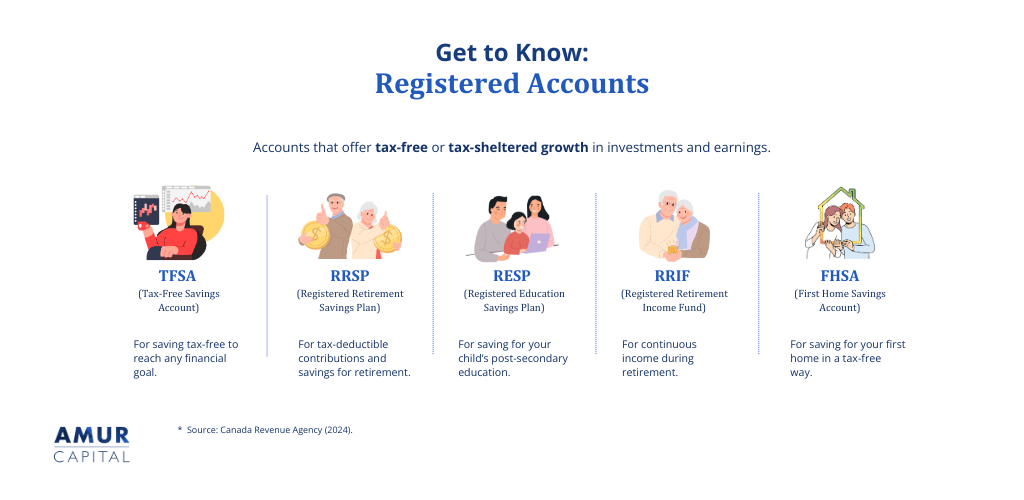
Features and benefits of registered accounts
The main feature of registered accounts is that they allow you to save and invest tax-free. For example, RRSPs will enable you to save money while helping you save on taxes by reducing your taxable income at the end of the tax year. Here are the benefits of registered accounts:
- Tax savings: Depending on the type of account, you may pay less on your investments than you would with a non-registered account. These savings allow you to allocate extra funds to other projects or invest in new assets.
- Tax deferral: Paying taxes in the future means more funds that can be used to meet your current financial needs. In addition, this tax liability may be reduced if you are in a lower tax bracket (e.g., in retirement) when the tax becomes payable.
- Faster compounding: When tax is deferred or sheltered in your investments, your investments have greater potential to grow and compound.
That said, registered accounts are governed by regulations, and they have limitations and restrictions, too. These are:
- Contribution limits: A contribution limit means capping how much you can put into your registered accounts, with some having annual or lifetime limits. For example, a Tax-Free Savings Account (TFSA) has a yearly contribution room of $7,000 for 2024 and 2025, plus any unused contribution room from previous years. Meanwhile, a Registered Education Savings Plan (RESP) has a lifetime limit of $50,000 per beneficiary.
- Eligible investment types: Only qualified investments, such as stocks, bonds, mutual funds, and GICs, can be held in a registered investment account. Real estate and cryptocurrency are excluded; however, investments like Mortgage Investment Corporations (MICs) are eligible and allow you to benefit from the real estate market without directly owning or managing a property.
- Withdrawal limits: You can withdraw anytime if your funds are not in a locked-in account, such as a Locked-In Retirement Account (LIRA). However, as in the case of RRSPs, you may be required to pay tax on your withdrawals.
Types of registered accounts in Canada
Whether you want to earn tax-free income, defer tax payments, or save for your child’s post-secondary education, there is a registered account for every need.
Tax-Free Savings Account (TFSA)
A Tax-Free Savings Account is a flexible investment account that allows you to contribute, grow, and withdraw money without being taxed or penalized. It can be used for any goal, such as education, retirement, and even a major purchase like a home or a vehicle.

The federal government introduced the TFSA in 2009 to encourage more people to save and invest by giving tax breaks on the investment income earned within the account, including tax-free withdrawals. However, unlike contributions to RRSPs that are tax-deductible, TFSA contributions cannot reduce your taxable income for the year.
Registered Retirement Savings Plan (RRSP)
A Registered Retirement Savings Plan (RRSP) is designed to help you save for retirement. It allows you to defer your income tax until after you retire, reducing your annual taxable income for the year you contribute.
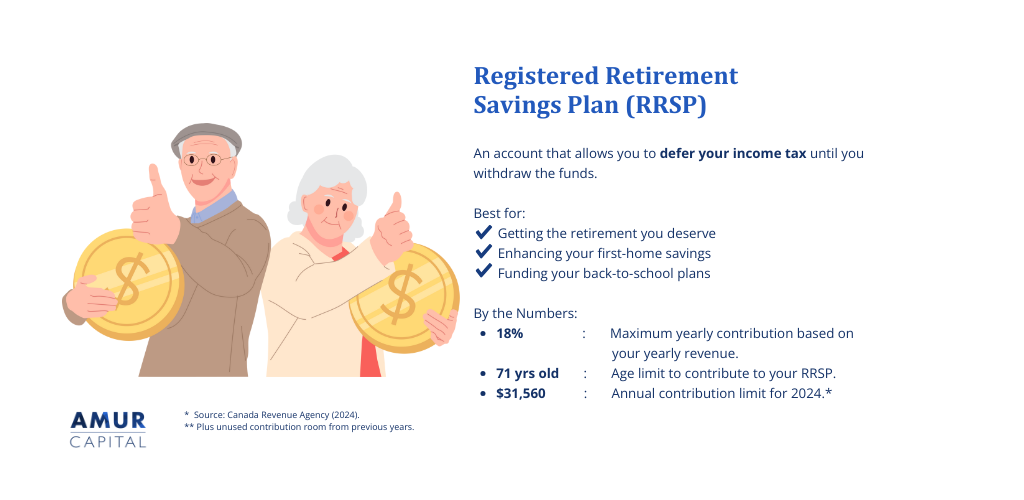
While you can invest up to 18% of your annual income tax-free from the previous year, it cannot exceed a set yearly limit. You also have the right to carry forward unused contributions for future use.
An RRSP can be a good choice for those seeking to maximize tax-free earnings while building their retirement nest egg. In addition, you can also use an RRSP for:
- Buying your first home: Through the Home Buyer’s Plan (HBP), you can withdraw up to $60,000 from your RRSP as a downpayment for your first home.
- Going back to school: Through the Lifelong Learning Plan (LLP), you can withdraw up to $20,000 from your RRSP (payable within ten years) to finance a full-time education or training program for you, your spouse, or your common-law partner.
Registered Retirement Income Fund (RRIF)
Simply put, the Registered Retirement Income Fund (RRIF) is a natural continuation of your RRSP. By the end of the year you turn 71, your RRSP needs to be converted to an RRIF to ensure you have a source of steady income during retirement.
Like RRSPs, an RRIF offers tax-deferred growth on the investment held within the account.

Registered Education Savings Plan (RESP)
The Registered Education Savings Plan (RESP) allows you to save tax-free for your child’s post-secondary education. The savings within the account grow tax-free until withdrawal. In addition, RESPs will enable you to receive government grants, such as the Canada Education Savings Grant (CESG) and Canada Learning Bond (CLB), to boost your savings further.
While you can contribute to an RESP until 31 years after it was opened, you can recover your savings or transfer them to an RRSP if the child decides not to continue their education. This provides some flexibility in managing your finances.

While you can contribute to an RESP until 31 years after it was opened, you can recover your savings or transfer them to an RRSP if the child decides not to continue their education. This provides flexibility in managing your finances while avoiding being locked in a specific investment.
First Home Savings Account (FHSA)
The First Home Savings Account (FHSA) is a new registered account designed to help first-time homebuyers save tax-free towards their first home. Similar to RRSPs, contributions to an FHSA are tax deductible up to $8,000 annually and a lifetime maximum of $40,000.

Withdrawals in an FHSA are tax-free when used to purchase your first home. There are also withdrawals without tax consequences (also known as qualifying withdrawals):
- Designated withdrawal: When you contributed too much and have an excess FHSA amount; or
- Amount otherwise included in your income: If the withdrawal is part of your taxable income, it may not be taxed again.
In all other instances, any amount taken from your FHSA will be taxed in the year it is withdrawn.
How do I open a registered account?
You can set up a registered account of your choice through a financial institution such as a bank, credit union, trust, or investment company. Before opening an investment account, however, be sure to:
- Check to see what types of investments you can purchase through an advisor;
- Know the fees and compensation structure related to the investments and the account; and
- Compare investment firms regarding their performance and reputation.
- What are investment options for registered accounts?
Not all investments are created the same. Even more so, every individual has their own financial goals, timelines, and risk tolerances. This is why it is important to start with an investment plan first to map out and personalize your investment journey.
Ready to invest? Here are some of the best investment options to consider for your registered accounts:
Stocks/ Equities
An equity is a direct investment in a business. Investing in stocks can yield higher returns but also comes with increased risks, as even top-performing stocks can stumble. If you are comfortable with market fluctuations, you can discuss with a financial advisor about allocating a portion of your registered account to equities to enhance your long-term growth potential.
Government and Corporate bonds
Buying a bond means lending money to a company or a government (bond issuer). Upon maturity, the issuer must repay the bond’s full face value along with any interest. Bonds may be a suitable choice if you want predictable growth in your investments.
Government bonds have significantly lower risk than corporate bonds. However, in exchange for this security, government bonds may provide lower returns than corporate bonds, which depend on the company’s credit rating and performance.
Mutual funds
Mutual funds provide diversification by allowing you to invest in a share of many more assets than you could buy individually. A fund manager decides where to invest the money, including buying and selling investments on your behalf. Mutual funds are a viable option for those who prefer a hands-off approach to investing.
Guaranteed Investment Certificates (GICs)
Guaranteed Investment Certificates (GICs) are lower-risk investments that guarantee your principal investment plus an agreed-upon interest. They are popular among beginner and conservative investors looking to preserve capital while earning higher interest than typical savings accounts.
Real Estate
Real estate is the world’s oldest and largest asset class, with a global value of over $370 trillion. It is also considered a smart hedge against inflation, with property values and rents rising together. Traditional real estate investing usually involves a lot of hands-on work, like managing rental properties, flipping houses, and making renovations.
A way to passively invest in real estate is through Mortgage Investment Corporations (MICs).
MICs function similarly to an investment fund; it pools money from investors to invest in highly diversified mortgages. MICs allow investors to access the Canadian real estate market without the volatility of traditional stocks or the hassles of property management.
Are registered accounts really tax-free?
When it comes to your investment earnings, registered accounts are tax-sheltered, meaning you won’t pay tax on the profit your investments have earned for the current fiscal year. That said, in some accounts, such as the RRSP, you must pay tax on that money when you withdraw it.
So, should you prioritize registered plans?
As mentioned above, unlike non-registered accounts, registered plans may be limited in terms of deposit and withdrawal limits. Consider comparing registered vs non-registered accounts to see which one can benefit you the most.

Maximize your tax-free earnings with Amur Capital MICs
Whether you want to save and invest for your first home, your child’s education, or your sunset years, registered accounts are a powerful tool to help you achieve your financial goals.
When paired with Amur Capital’s trio of Mortgage Investment Corporations (MICs), you can enjoy consistent returns while enjoying tax-free growth:
- Amur Capital Conservative Income Fund (ACCIF) provides investors with stability in returns and reliable income, with a focus on residential first mortgages.
- Amur Capital Income Fund (ACIF) offers investors a blend of stability and income growth. Established in 1984, it focuses on first—and second-home mortgages.
- Amur Capital High Yield Fund (ACHYF) is for investors willing to accept an increased level of risk. The fund focuses on higher ratio mortgages over shorter terms.
Got questions regarding our funds? Contact our Investor Relations team today!
FAQs
What are registered accounts in Canada?
Registered accounts are tax-advantaged accounts created by the federal government to encourage saving among Canadians, especially for significant milestones such as retirement, education, and their first home. These accounts allow tax-sheltered growth in investment earnings and savings.
What is the difference between registered and unregistered accounts?
Registered accounts such as RRSPs, FHSAs, TFSAs, and RESPs let you grow your savings tax-free. Unregistered accounts offer no tax benefits but allow for more flexibility in contribution and type of permitted investments.
What are the registered plans in Canada?
Registered plans such as RRSPs and RESPs offer tax-free growth on investments while allowing you to defer tax upon withdrawal.
Are TFSAs and RRSPs registered accounts?
Yes, both TFSAs and RRSPs are registered accounts.