


As you approach retirement, ensuring a steady income stream to fund your sunset years becomes crucial. This is where a Registered Retirement Income Fund (RRIF) comes into play. In this guide, we’ll explore the key features, benefits, and considerations of an RRIF, helping you navigate your retirement income options more effectively.
Key Takeaways:
- A RRIF is a retirement account designed to provide income in retirement.
- RRIF converts your Registered Retirement Savings Plan (RRSP) into a fund focused on income generation. You must transition to a RRIF by the end of the year you turn 71.
- Amur Capital’s trio of Mortgage Investment Corporations (MICs) are eligible for RRIFs, which can provide a source of stable income during your retirement.
What is a RRIF?
Simply put, a RRIF is a Canadian retirement vehicle designed to provide income. It is a natural continuation of your Registered Retirement Savings Plan (RRSP), which you must convert to a RRIF by the end of the year you turn 71, ensuring you start withdrawing funds to support your retirement lifestyle. Until then, you can continue putting money into your RRSP to maximize your retirement savings.
 Get to know RRIF by the numbers. Illustration by Amur Capital.
Benefits of a RRIF
1. Flexible withdrawal options
A RRIF offers significant flexibility regarding withdrawals. You can choose how much money to take out each year, provided you meet the minimum withdrawal requirements set by the government. This flexibility allows you to tailor your income to your specific needs, whether you want to take larger withdrawals during certain years or conserve funds during others.
2. Tax-deferred investment income
While you must withdraw a minimum amount each year, any funds that remain in the RRIF can continue to grow without being taxed until they are withdrawn. This can be a powerful tool for managing your tax liabilities and maximizing your retirement savings.
3. Tax-free assets transfer
RRIFs also offer advantages for estate planning. Upon your death, any remaining funds in your RRIF can be passed on to your beneficiaries, typically without incurring probate fees. Additionally, if your spouse or common-law partner is named as the beneficiary, they can transfer the RRIF assets to their own RRIF or RRSP, allowing for continued tax-deferred growth.
How does a RRIF work?
In Canada, once you hit the maximum age for an RRSP (71 years old), you have two choices: take all your savings out at once (which can lead to a hefty tax bill) or withdraw smaller amounts over time. If you choose the second option, you’ll need to move your savings to a retirement account like a RRIF or an annuity.
By making smaller, regular withdrawals, you can manage your tax payments more effectively and keep more of your money for yourself.
RRIF contributions
You can no longer contribute additional funds once you have converted your RRSP to a RRIF. However, if you have other registered accounts, such as a Tax-Free Savings Account (TFSA), you can still contribute to those accounts to supplement your income.
The focus of an RRIF is on managing withdrawals rather than contributions.
RRIF withdrawals
The Canadian government sets a minimum withdrawal amount that you must take from your RRIF each year. This amount is calculated based on your age and the value of your RRIF at the beginning of the year. The minimum withdrawal percentage increases as you age, ensuring you draw down your retirement savings over time.
For example, if you are 75 years old and the overall balance of your RRIF at the beginning of the year was $150,000, you would be required to withdraw 5.82%, amounting to $8,730. The following year, the percentage would increase to 5.98%.
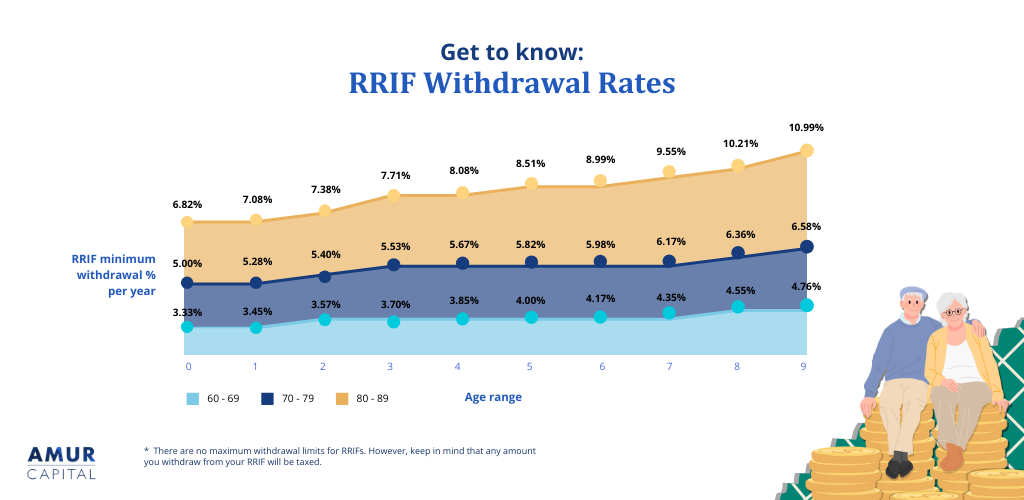 RRIF withdrawal rates. Illustration by Amur Capital.
While the minimum withdrawal is mandatory, you can withdraw more than the minimum if your financial situation requires it. You can also choose to make regular monthly, quarterly, semi-annual, or annual withdrawals. Remember that any amount you withdraw is considered taxable income for that year.
Another thing to consider is “in kind” withdrawals. These are particularly helpful if you don’t need the income from the RRIF as cash right away. With “in kind” withdrawals, you can transfer the investments directly to a non-registered account or a TFSA (provided you have the remaining contribution room for that year).
Registered Retirement Income Fund (RRIF) vs Registered Retirement Savings Plan (RRSP) vs Life Income Fund (LIF)
Navigating retirement planning in Canada can be tricky, from deciding the best retirement age to understanding the differences between savings vehicles like Registered Retirement Savings Plans (RRSPs) and income vehicles such as Registered Retirement Income Funds (RRIFs) and Life Income Funds (LIFs).
Each option serves a unique purpose in your financial journey, whether saving for the future or managing your income during retirement. Here’s how they differ:
RRSP
A RRSP is primarily a savings vehicle for retirement. Contributions to a RRSP are tax-deductible, and the funds grow tax-deferred until withdrawal. You can contribute to a RRSP until the end of the year in which you turn 71.
There are various RRSPs, from individual to spousal to group, each serving different needs. RRSPs can also hold diverse investments like GICs, mutual funds, ETFs, and alternative assets like Mortgage Investment Corporations (MICs).
RRIF
A RRIF is designed to generate income during retirement. You can withdraw funds but cannot contribute additional money, so the focus shifts from accumulating savings to providing income. To ensure a gradual drawdown of your savings, the government establishes a minimum annual withdrawal percentage for RRIFs.
Like RRSPs, RRIF accounts can hold qualified investments such as stocks, GICs, and ETFs and select alternative assets.
LIF
A Life Income Fund (LIF) is similar to a RRIF but is specifically designed for individuals who have accumulated pension funds. LIFs have specific rules regarding withdrawals, often limiting the amount you can take out each year to ensure the funds last throughout your retirement.
 RRIF vs RRSP vs LIF. Illustration by Amur Capital.
Regardless of your chosen retirement option, all three accounts can hold qualified investments, which are government-identified investments that are eligible for tax-advantaged accounts.
Three things to consider with your RRIF
When to convert an RRSP to RRIF
Timing your conversion from a RRSP to a RRIF is essential. The government mandates that you convert your RRSP by the end of the year in which you turn 71. However, many individuals choose to convert earlier, especially if retiring before this age. Consider your financial needs, tax implications, and investment strategy when deciding when to switch.
Income and withholding taxes
Since RRIF withdrawals are considered taxable income, understanding the income tax implications of these withdrawals is critical. Consider working with a financial advisor or tax professional to strategize your withdrawals to minimize your tax burden.
There’s no maximum annual withdrawal limit for your RRIF, but all withdrawals are fully taxable. Withholding tax is deducted from excess RRIF payments, and your financial institution will withhold an amount based on your tax rate and pay it to the government.
 RRIF withholding tax rates. Illustration by Amur Capital.
The withholding tax rate is 10% for amounts exceeding $5,000 from the minimum amount, with an incremental increase of 10% per level.
It’s a good idea to consult a financial advisor to determine the best way to manage your withholding tax on RRIF payments. They can help you understand the tax implications of your RRIF withdrawals and ensure you take advantage of any available tax credits or deductions.
Investment options
 Retirement investing options. Illustration by Amur Capital.
While you cannot contribute to a RRIF, you can choose how your funds are invested within the account. This includes options such as stocks, bonds, mutual funds, and other investment vehicles. Some of the investment options include:
Guaranteed Investment Certificates (GICs)
Guaranteed Investment Certificates (GICs) offer a secure way to grow your money, ensuring 100% of your principal and interest when held until maturity. These low-risk investments are backed by the Canada Deposit Insurance Corporation (CDIC) for up to $100,000. Plus, any interest earned on GICs within an RRIF is tax-free, making them an attractive option.
Mutual Funds and Exchange-Traded Funds (ETFs)
Mutual funds pool resources from multiple investors and provide access to a diverse array of stocks, bonds, and other securities, allowing for broad investment exposure. Similarly, ETFs function like mutual funds but trade on stock exchanges, akin to individual stocks, and typically come with lower fees. Both mutual funds and ETFs allow capital gains and dividends to grow tax-deferred within an RRIF until you withdraw.
Stocks and Bonds
Stocks represent ownership in companies and can offer significant returns, although they carry a higher risk due to market fluctuations. In contrast, bonds are debt instruments issued by governments or corporations. They provide fixed interest payments and generally present a lower risk profile compared to stocks.
Alternative investments
Alternative investments offer unique advantages over traditional stocks and bonds due to their low correlation with conventional equity and fixed-income markets. These assets can enhance portfolio diversification and serve as an additional income source during market downturns.
In Canada, Mortgage Investment Corporations (MICs) are a popular choice for those looking to invest in real estate without the complexities of property management. Amur Capital MICs are RRSP-eligible, enabling you to tap into the real estate market through high-yield mortgages while enjoying the tax benefits of tax-free growth and tax deferral associated with RRSPs.

Why invest your RRIF money with Amur Capital MICs
Whether you’re nearing retirement or already enjoying your golden years, a well-managed RRIF can provide the income stability you need to enjoy life to the fullest. By understanding how a RRIF works, its benefits, and the considerations involved, you can make informed decisions that align with your financial goals.
Investing your RRIF funds wisely can significantly impact your retirement income. Amur Capital offers three Mortgage Investment Corporations (MICs) as investment options for your RRIF.
- Stable returns: MICs provide consistent income like other fixed income instruments but offer a higher yield than some traditional fixed-income investments like government bonds, making them an attractive option for retirees seeking income.
- Diversification: Investing in MICs allows you to diversify your portfolio, potentially reducing risk and enhancing the potential for returns.
- Eligible for tax-advantaged accounts: All three fund offerings are eligible investments for RRSP, RRIF & TFSA plans.
Ready to invest? Contact a member of our Investor Relations today to learn more.
FAQs
How much do I have to withdraw from a RRIF each year?
The minimum withdrawal amount from a RRIF is calculated based on your age and the value of the RRIF at the beginning of the year. The percentage increases as you age, starting at 5.28% at age 71 and reaching 20% by age 95.
What happens to a RRIF when I die?
Upon your death, any remaining funds in your RRIF can be transferred to your designated beneficiaries. If your spouse or common-law partner is the beneficiary, they can transfer the RRIF assets to their own RRIF or RRSP, allowing for continued tax-deferred growth.
How do I avoid tax on RRIF?
While you cannot entirely avoid tax on RRIF withdrawals, you can strategize withdrawals to minimize your tax burden. Consult a tax professional to plan and implement tax-efficient withdrawal strategies that complement your lifestyle and income needs.


