

[vc_row][vc_column width=”2/3″][vc_column_text]If you live and work in Canada, you may have already encountered a T4 slip. This guide explains what a T4 is, who receives one, and how to access it, ensuring you’re well-prepared for a smooth tax season. Plus, learn how certain investments and tax-advantaged accounts can maximize your financial opportunities.
Key Takeaways:
- A T4 Slip (Statement of Remuneration Paid) is a Canadian tax document provided by an employer summarizing an employee’s earnings and deductions for the year.
- Most employers send T4s to their employees electronically by the end of February after the preceding calendar year.
- RRSP contributions, childcare expenses and pension adjustments are common tax deductions in Canada. Contributions to tax-advantaged accounts, such as RRSPs and FHSAs, can also reduce taxable income.
[/vc_column_text][ld_spacer][vc_column_text]
What is a T4 slip?
[/vc_column_text][vc_column_text]The T4 Slip, otherwise known as the Statement of Remuneration Paid, summarizes your income and any deductions (such as income tax and pension contributions) for the calendar year. This income can include any of the following amounts paid to you by your employer:
- salary or wages
- commissions
- bonuses
- vacation pay
- taxable benefits
If you have worked multiple jobs, you’ll receive a separate T4 slip from each employer. You’ll also receive different T4s for each province and territory where you earned income. [/vc_column_text][ld_spacer][vc_column_text]
Understanding the T4 Slip
[/vc_column_text][vc_column_text]
Who gets a T4 slip?
Employees receive the T4 slip electronically or by mail from their employers. An identical copy is also sent to the Canada Revenue Agency (CRA) to ensure tax compliance, verify reported income, and keep an accurate record of both the employers and employees.
What is a T4 tax form used for?
T4 tax forms are primarily used to report employee income, deductions, and other required information for tax purposes, as the Income Tax Act requires. They help both the employer and employee report accurate income and tax details.
Who needs to file a T4?
Employers need to file T4 slips when they have paid employees or other workers (such as contractors) during the tax year the following:
- salaries, wages, bonuses or other remuneration (must be more than $500)
- taxable benefits or allowances
- pension benefits
If the employer provides a taxable employee benefit plan, such as group term life insurance, to its employees, the former must also report the amounts on a T4 slip, even if the total remuneration for the year is less than $500.
On the other hand, clients do not need to issue T4 slips to freelancers. Instead, they may issue a T4A Slip if the freelancer earns more than $500. Freelancers must report this income and other remuneration directly on their tax returns through the T1 Personal Income Tax form.
When can I expect my T4?
You can expect your T4 to arrive annually in the first week of March or earlier. Employers are required to file on or before the last day of February after the preceding calendar year, or they may face late filing penalties.
How do I get my T4?
You can get your current tax year T4 online, either from your employer or from the CRA website. Most companies send their employees a digital softcopy of their T4s, which you can access through the company portal. You can also secure your T4 slips if you have a CRA My Account as soon as your employer files them to the CRA.
Types of T4 slips
There are several types of T4 slips, each serving a specific purpose. The most common is the T4 (Statement of Remuneration Paid), in which employers issue employees to report income and deductions for the year.
Other types include:
- T4A (Statement of Pension, Retirement, Annuity, and Other Income): covers various other forms of income such as pensions and annuities.
- T4E (Statement of Employment Insurance and Other Benefits): used to report Employment Insurance benefits.
- T4RIF (Statement of Income from a Registered Retirement Income Fund): This form reports income received from a Registered Retirement Income Fund, typically during retirement.
- T4RSP (Statement of RRSP Income): This statement details income withdrawn from a Registered Retirement Savings Plan, which is often used for retirement funding.
- T4A-OAS (Statement of Old Age Security): provides information about the Old Age Security benefits received by individuals aged 65 and older.
- T4AP (Statement of Canada Pension Plan Benefits): outlines the benefits received from the Canada Pension Plan, which provides financial support during retirement or disability.
[/vc_column_text][ld_spacer][vc_column_text]
What is a T4 summary?
[/vc_column_text][vc_column_text]Also known as the Summary of Remuneration Paid, the T4 Summary represents the total dollar amounts reported on all the T4 Slips the employer provided for each employee in the current calendar year. The employer submits both the T4 and T4 Summary to the CRA.[/vc_column_text][ld_spacer][vc_column_text]
What does a T4 Slip look like? 5 most important sections to know
[/vc_column_text][vc_column_text]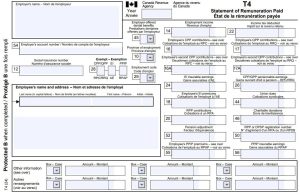
Sample T4 Slip. Source: Canada Revenue Agency (CRA).
The T4 Slip simplifies Canadian tax filing by detailing your annual income and deductions. However, it must be accurate to avoid penalties or delays. For seamless compliance, pay attention to these five key sections:
Box 12: Social Insurance Number (SIN)
Your SIN is a unique identifier ensuring your earnings and deductions are correctly linked to your Canada Revenue Agency (CRA) records. Verify its accuracy to avoid processing delays or identity-related issues.
Box 14: Employment income paid
This box reflects your total taxable employment income, including wages, bonuses, commissions, and taxable benefits (e.g., employer-paid health insurance). Double-check this figure, as it forms the basis for calculating your tax obligations.
Which amounts are included in my employment income?
Employment income covers salaries, overtime pay, tips, taxable allowances (e.g., car allowances), and non-cash benefits like stock options. Excluded items typically include non-taxable reimbursements (e.g., work-related travel expenses) and contributions to registered pension plans.
Box 16/17: Canada Pension Plan (CPP)/ Quebec Pension Plan (QPP)
These boxes show contributions to CPP (Canada-wide) or QPP (Quebec residents). Both employees and employers contribute a percentage of earnings up to an annual maximum. Confirm these deductions align with your pay stubs for retirement benefit eligibility.
Box 18: Employment Insurance
This box lists EI premiums deducted from your income, which fund temporary financial support during unemployment or maternity/parental leave. Ensure deductions match your earnings to avoid discrepancies in future benefit claims.
Box 22: Income Tax Deducted
This is a crucial section that summarizes federal and provincial taxes withheld by your employer. Compare it to your total income (Box 14) to estimate potential refunds or balances owed. Errors here could lead to audits or penalties.
Deductions on your T4 Slip
As an employee, it’s crucial to be aware of the various deductions from your salary and how they impact your take-home pay.
Understanding deductions
Deductions on your T4 slip can include income tax, Canada Pension Plan (CPP) contributions, Employment Insurance (EI) premiums, and union dues. These deductions are typically made by your employer and are reported on your T4 slip.
Common deductions and their impact
By law, employers must deduct the following amounts from your paystub:
- Income tax: This is the tax deducted from your salary and paid to the Canada Revenue Agency (CRA) on your behalf. Canada uses a progressive tax system, which means the more you earn, the more you may owe in taxes. And as you move into different tax brackets, the portion of your income that falls within each one gets taxed at a higher rate.
- CPP contributions: These are contributions to the Canada Pension Plan, which provides retirement benefits to eligible Canadians.
- EI premiums: These are premiums paid to the Employment Insurance program, which provides financial assistance to eligible Canadians who are unemployed or unable to work due to illness or injury.
On the other hand, some deductions can reduce your taxable income, putting you in a lower tax bracket. Some of the tax deductions you can claim in Canada include:
- RRSP Contributions: Depending on your maximum allowable amount per year, contributions to your Registered Retirement Savings Plan (RRSP) can reduce your taxable income for the year.
- Pension adjustment
- Realized capital losses
- Childcare expenses
[/vc_column_text][ld_spacer][vc_column_text]
Managing your T4 Slip
[/vc_column_text][vc_column_text]
How do I get past T4 tax slips?
You can access your current and past T4 slips from the CRA website’s “My Account” section. You can also ask your current or former employers for a copy of your T4s since employers must keep paper and electronic records on file for six years.
What if there is a mistake on my T4 slip?
If you suspect your T4 has errors, you should contact your employer immediately to have them fixed before your taxes are due.
How long should I keep my T4?
You can keep your T4s for as long as you like. However, you can only access your current and previous six years’ tax slips on the CRA website.
When is the deadline for T4 slips?
Employers must submit T4s on or before the last day of February after the preceding calendar year or risk being subject to late filing penalties. If you do not receive one by the last day of February, reach out to your employer.
What to do if your T4 is lost
Even if you accidentally lose a physical copy of your T4, don’t lose hope. The CRA also receives these forms and usually has a copy. You can access it quickly through your CRA My Account or request a copy to be sent to you.
3 considerations when filing your taxes in 2025
Stay informed with changes in tax legislation
There have been several recent changes and updates to T4 slips that you should be aware of. Here are some key changes:
- Employer-offered dental benefits: For calendar year 2023 and after, employers must indicate whether the employee or any of their family members were eligible to access any employer-offered dental benefits.
- Temporary relief from late-filing penalties and interest: Citing “ongoing challenges” faced by some filers, CRA waives late-filing penalties for T4, T4A and T5 slips filed by March 7, 2025, although the deadline remains February 28, 2025.
- Capital gains inclusion rate change deferred to January 1, 2026: With the deferral of the capital gains inclusion rate change from June 25, 2025, to January 1, 2026, the reporting requirements for capital gains related to employee security options will remain unchanged until the new date. This means employers will continue using the existing sections until the new inclusion rate takes effect.
Staying up-to-date with these changes is essential to meeting your tax obligations and taking advantage of available deductions and credits.
Ensure accurate reporting of employment income
To ensure that your T4 slip is accurate and complete, following best practices for managing your T4 slips is essential. Here are some tips:
- Review your T4 slip carefully: Make sure all the information on your T4 slip is accurate and complete, including your name, address, and social insurance number. Ensure that any top-ups under supplementary unemployment benefit plans are accurately reported.
- Verify your deductions: Check that your deductions are correct and that you are not missing any deductions that you are eligible for.
- Report errors: If you notice any errors on your T4 slip, report them to your employer or the CRA as soon as possible.
Utilize tax-advantaged accounts
Tax-advantaged accounts, such as Tax-Free Savings Accounts (TFSAs), Registered Retirement Savings Plans (RRSPs), and First Home Savings Accounts (FHSAs), allow you to save and invest tax-free. You may also benefit from:
- Tax deduction: The money you invest in your RRSP is tax-deductible, which means you can lower your total tax bill for the calendar year. For example, if you earn $70,000 a year and contribute $5,000 to your RRSP, your taxable income may be reduced to $65,000, lowering your tax liability and potentially putting you in a lower tax bracket.
- Faster compounding: When tax is deferred or sheltered in investments, these investments have a greater potential to grow and compound.
[/vc_column_text][ld_spacer][vc_column_text]
How Amur Capital MICs can help
[/vc_column_text][vc_column_text]The T4 slip is a vital document for navigating your Canadian tax responsibilities. It provides a clear overview of your employment income and deductions so you can file accurately and maximize your refunds.
To further strengthen your financial planning, consider tax-advantaged accounts like a TFSA or RRSP. As mentioned above, these registered accounts allow you to save tax-free for any goal, whether it’s for your personal savings, your child’s education, or your retirement nest egg.
By investing with Amur Capital’s Mortgage Investment Corporations (MICs), you can accelerate your savings rate and reach your financial goals faster. Our MICs are RRSP/TFSA-eligible, so you can turn your tax savings into compounding growth. Here’s why you should consider MICs:
- Tax efficiency: MIC distributions, when invested in a registered account like in a TFSA and RRSP, can grow tax-free or tax deferred.
- Predictability: Consistent income streams can complement retirement planning.
- Diversification: Invest in Canada’s thriving real estate without the hassle of property management.
Depending on suitability, investors can find the appropriate fund below to fit their risk appetite with Amur Capital:
- Amur Capital Conservative Income Fund (ACCIF) provides investors with stability in returns and reliable income, with a focus on residential first mortgages.
- Amur Capital Income Fund (ACIF), established in 1984, offers investors a blend of stability and income growth. It focuses on first—and second-home mortgages.
- Amur Capital High Yield Fund (ACHYF) is for investors willing to accept an increased level of risk. The fund focuses on higher-ratio mortgages over shorter terms.
Got questions regarding our funds? Contact our Investor Relations team today! [/vc_column_text][ld_spacer][ld_spacer][/vc_column][vc_column width=”1/3″][vc_wp_search][vc_wp_posts number=”5″][/vc_column][/vc_row]


